
Michele Simoncelli receives the 2025 Charles Haenny Prize in Physics
Michele Simoncelli, Assistant Professor in the Department of Applied Physics and Applied Mathematics at Columbia University, is the recipient of the 2025 Charles Haenny Prize for Physics, which recognizes research of “excellent scientific quality and internationally competitive, while also respectful of humanity and its environment”. The prize was awarded to Simoncelli in Lausanne, Switzerland, with the following citation: “For the development of novel microscopic and mesoscopic theories of thermal transport that find direct application in a better understanding of heat transport and a reduction of energy consumption in various fields.”
The Charles Haenny Prize is awarded by the Institute of Physics of EPFL and the Société Académique Vaudoise (SAV). It is supported by an endowment from Charles Haenny, who demonstrated in 1939 that nuclear fission emits neutrons—a cornerstone for nuclear chain reactions—and later signed with Halban, Joliot, and Kowarski the first French patent on nuclear energy. Very concerned about ethical issues, he warned of nuclear energy’s dangers and, after retiring in 1972, established the Groupe Université-Tiers Monde questioning the objectives of scientific research when dealing with development challenges. In 1996, he created the Charles Haenny Prize Fund to recognize discoveries in physics that benefit humanity from the scientific, environmental, and ethical perspectives.
The award recognizes Simoncelli’s early-career contributions, which started during his PhD in Nicola Marzari’s group at EPFL, then moved to the Theory of Condensed Matter (TCM) group at the University of Cambridge, and now continue in Simoncelli’s group at Columbia University. Examples include: First, the development of a unified theory of thermal transport in crystals and glasses, and its application to find hybrid crystal–glass refractory materials that reduce energy consumption and carbon footprint in steel furnaces. Second, the development of a theoretical framework to shed light on how to induce and amplify non-diffusive transport of heat and charge, proposing approaches and proof-of-concept experiments to address overheating in electronic devices. Third, the explanation of how atomic composition and structure influence heat-shield performance in applications from eco-friendly jet engines to nuclear-fusion reactors.
After the ceremony, Simoncelli said: “Haenny’s story, his commitment to ethically conscious research, and his vision for how science should address development challenges are truly inspiring. The award—a double-pan balance with atomistic physics on one side and the Earth on the other—exemplifies Haenny’s values: combining scientific excellence with social responsibility, integrity, and environmental stewardship. It sits on my desk, serving as daily motivation and inspiration to continually strive in pursuit of Haenny’s values.”
At Columbia, the Simoncelli group develops the theoretical and computational framework to understand, quantitatively describe, and control quantum transport phenomena in solids and liquids involving, e.g., charge, heat, light and spin, their possible synergies or conflicts, and related macroscopic signatures. The ambition is twofold: first, to evolve current materials for eco-friendly storage and management of information or energy, and second, to innovate on existing applications or even conceive new ones, in collaboration with experimentalists and industry. In Spring 2026, Simoncelli will teach the state-of-the-art AI-based atomistic simulation techniques used by his group in the course ‘Atomic Foundation Models’ (APPH4990E).
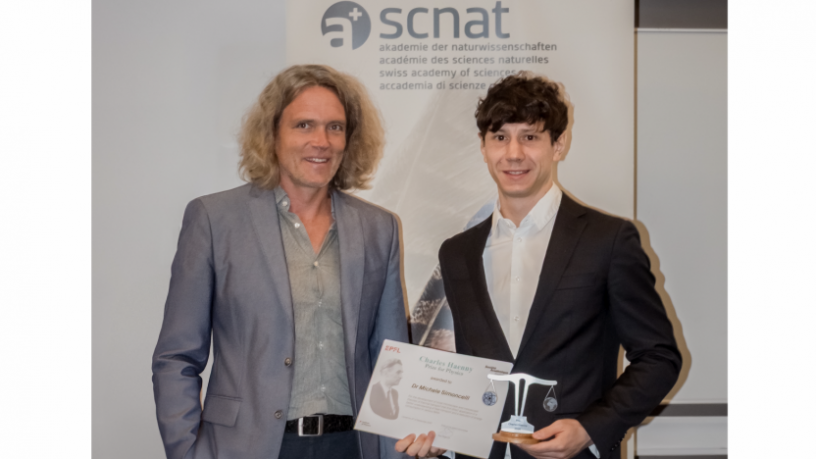
Prof Hugo Dil (right), Head of the Charles Haenny Prize Committee, presents the 2025 Charles Haenny Prize to Prof Michele Simoncelli (left) at the award ceremony in Lausanne, Switzerland.