
Inaugural Hackathon Hosted by Fusion Research Center
Columbia Fusion Research Center students, researchers and faculty hosted the 2025 Perturbed Equilibrium Hackathon June 28–30. The concentrated effort of the hackathon laid the foundations for a new, open source Julia code that will reproduce the major functionalities of the Generalized Perturbed Equilibrium Code (GPEC) package with improvements in speed, numerical robustness and flexibility for future expansion of physics capabilities.
The event, organized by Research Scientist Dr. Nikolas Logan and hosted by the Fusion Research Center, provided the opportunity for Columbia undergraduate and graduate students to work alongside fusion industry researchers from General Fusion, Brennan Fusion Research and General Atomics to learn and contribute high impact work. Participation from Princeton University and Seoul National University greatly accelerated progress as well, establishing new and strengthening existing collaborations within the 3D magnetohydrodynamics (MHD) tokamak physics community.
Daily scrums included presentations from Dr. Meneghini (General Atomics) on “How to use the Integrated Modelling & Analysis Suite (IMAS) in Julia”, Dr. Lyons (General Atomics) on “Best Practices and Speed Optimization in Julia”, and Prof. Park on “Next steps: Physics extension priorities”. Getting down into the code, Columbia students Matthew Pharr and Rithik Banerjee led a team to reproduce the capabilities of Dr. Chance’s fortran Vacuum code in Julia, students Jake Halpern and Meg Fairborn worked on the fundamental Euler-Lagrange integration scheme to calculate stability by reproducing the Direct Criterion of Newcomb (DCON) while students Danial Burgess and Evan Bursch concentrated on establishing the initial axisymmetric equilibrium representations about which 3D MHD perturbations are assessed.
The code produced by these team efforts lays the foundation for modeling the MHD stability and response to 3D fields of modern day tokamaks as well as future reactors. The event served to efficiently establish a broad developer base for the new premier 3D MHD modeling suite, connecting university students and private industry researchers in what we are sure will prove to be lasting and productive collaborations.
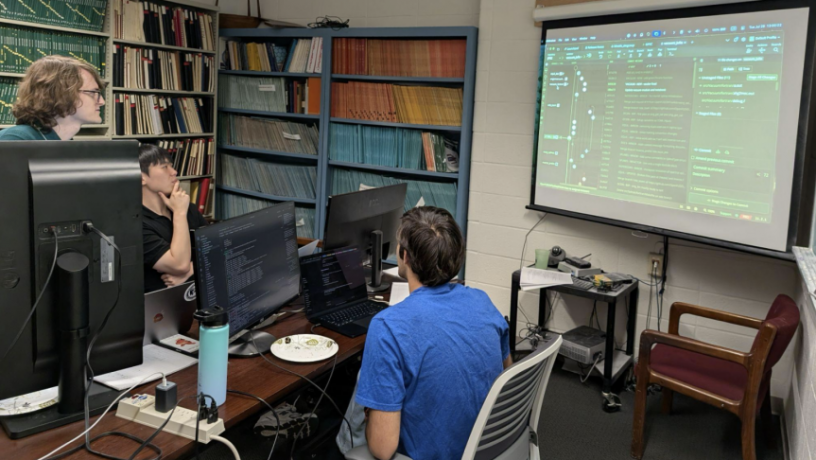
Columbia graduate student Mathew Pharr, SNU Graduate student Jaebeom Cho and Columbia undergraduate Rithik Banerjee, from left to right, discuss optimization of the new Julia code structure before diving into the coding.
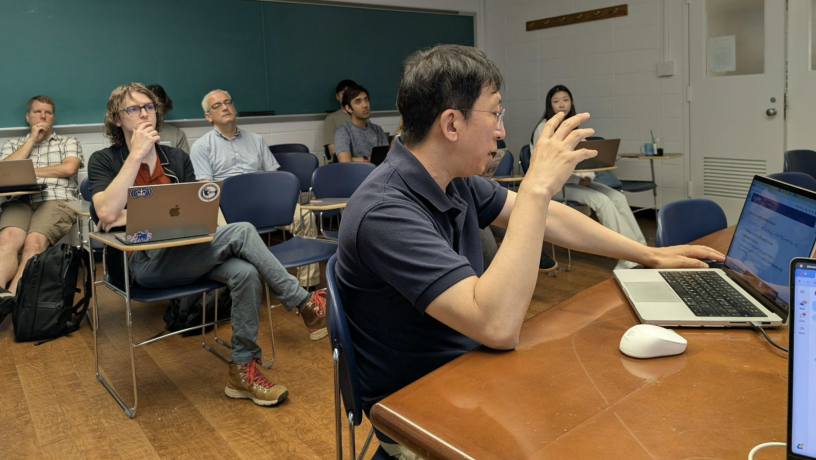
Seoul National University professor Jong-Kyu Park presents his vision of the most promising next physics extensions for the generalized perturbed equilibrium code.
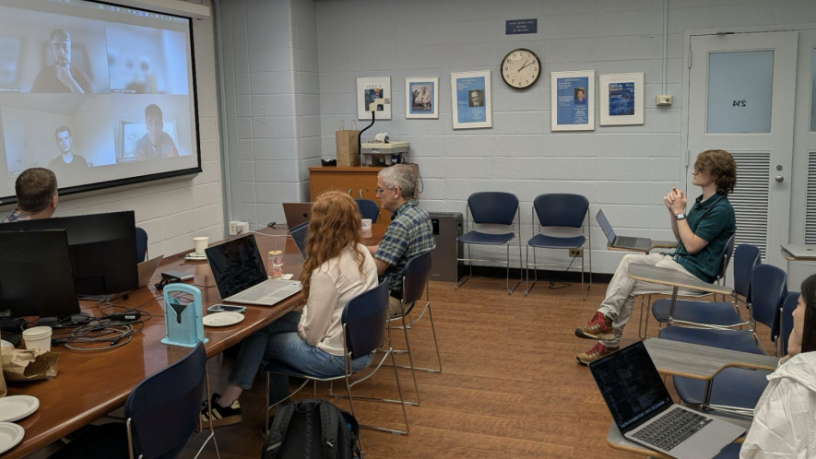
Students and private fusion industry researchers worked together to optimize the new physics modeling architecture, sharing Julia and physics expertise live while actively writing the code during this concentrated effort in the Hackathon.