
Columbia University Students, Scientists, and Faculty Present at the 2025 Annual Meeting of the APS Division of Plasma Physics
Columbia University students, scientists, and faculty arrived in Long Beach, CA to present their research results and interact with colleagues at the 67th Annual Meeting of the American Physical Society (APS) Division of Plasma Physics from November 17-21, 2025. Columbia plasma physicists presented over a hundred presentations to an international audience of more than 2,200 participants.
Highlights of the meeting were those invited presentations, representing the most exciting results achieved during the past year. Matthew Tobin, doctoral student working with Dr. Steve Sabbagh, presented "Avoidance of Disruptions due to Vertical Displacement Events via Novel Real-Time Stability Assessment." Tobin described how fast profile measurements can improve forecaster performance for real-time disruption avoidance while minimizing impacts to tokamak fusion performance. Dr. Jeff Levesque presented "Disruption dynamics during the first operation of a Runaway Electron Mitigation Coil (REMC) on a tokamak," which has been successfully installed and benchmarked on Columbia University's HBT-EP tokamak. Dr. Antoine Baillod, working with Prof. Elizabeth Paul, lectured about "Design and optimization of the Columbia Stellarator eXperiment," where Baillod presented an example how stellarator physics objectives can be achieved with tight engineering constraints, including the use of non-insulated high-temperature superconducting coils. Prof. Gerald Navratil presented "Observation of Burning Plasma Dynamics in DIII-D" and reported on novel experiments in the DIII-D tokamak that reproduced the dynamics that will occur in future burning plasma devices for fusion energy. These experiments uncovered fascinating collective dynamics and established a test-bed for simulating fusion burn dynamics and testing burn control techniques needed for long pulse high fusion gain experiments.
The meeting also included two tutorial presentations targeting a wide audience and inspiring early career scientists. Prof. Lorenzo Sironi, Columbia's Department of Astronomy, introduced "Relativistic Magnetic Reconnection in Astrophysical Plasmas," and explained how modern high-performance computation reveals the physics underlying plasma physics near black holes and neutron stars. Prof. Piero Martin, from University of Padova, spoke of the "Fusion history lessons for our times," based on his Columbia University course developed while on his sabbatical visit in Spring 2025 and reminded students that "best of our science and collaboration is needed for the goal of fusion energy."
In keeping with the meeting's goals to promote education and partnerships, the meeting had a special session for undergraduate students and a conference-within-a-conference to provide the APS Division of Plasma Physics community a comprehensive look across a range of private fusion companies to advance the physics and technology for a fusion pilot plant.
In the undergraduate session, Sonia Sobel (visiting from Carleton University) presented her research titled "Energy-resolved Detection of Hard X-Rays on the HBT-EP Tokamak." Amelia Koff (visiting from Davidson College) presented her work titled "Attainable Plasma Configurations for the Columbia University Tokamak for Education using TokaMaker." From Columbia University, Beruktawit Gebreamlak presented "High-Temperature Superconducting Non-Planar Coil Development: From Design to Cryogenic Testing," and Thomas Wang presented "Coupling ThinCurr and GPEC to Assess the Stability Implications of Induced Currents in Fusion Devices." Michael Campagna (visiting from William & Mary) presented their work "Effect of symmetry breaking on neoclassical flow damping in the Columbia Stellarator eXperiment."
Prof. Carlos Paz-Soldan, Dr. Ian Stewart, and Prof. Stephanie Diem (from University of Wisconsin), organized a two-day conference featuring all eight fusion companies participating in the U.S. Department of Energy Milestone program and representing public-private investment in fusion energy. The program also included a select number of international participants, and the conference highlights included presentations from Columbia University alumni Dr. Benjamin Levitt (PhD 2024 and Zap Energy Inc.) and Dr. Ryan Sweeney (PhD 2017 and Commonwealth Fusion Systems) and from APAM doctoral student Sophia Guizzo.
An important tradition of the APS Annual Meeting of the Division of Plasma Physics is the Columbia University Plasma Physics Group Reunion Dinner. A record number of students, scientists, and alumni celebrated the many contributions, the traditions of learning, and broad avenues of progress launched from Columbia University Plasma Physics.
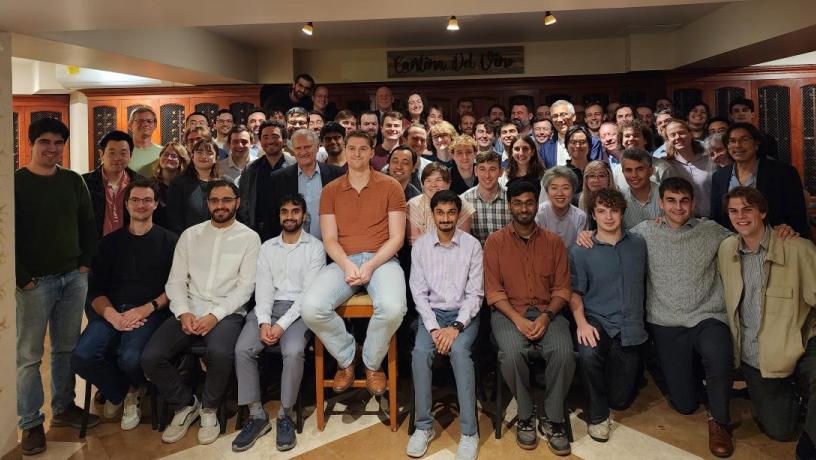
2025 Columbia University Plasma Physics Group Reunion Dinner