APAM Students Shine at the 2026 Senior Design Expo
The annual Senior Design Expo returned this May, bringing another remarkable showcase of student ingenuity. With over 60 projects and more than 200 participants across nine departments, this year's event was a testament to the talent and dedication of Columbia Engineering's graduating class — and APAM undergraduates were no exception.
Each year, the Expo gives students the opportunity to bring together everything they've learned — from foundational math and science to advanced engineering coursework — into innovative, purposeful designs and prototypes. This year, APAM students presented projects that spanned materials science, applied physics, applied mathematics, and beyond, tackling some of today's most pressing scientific and engineering challenges.
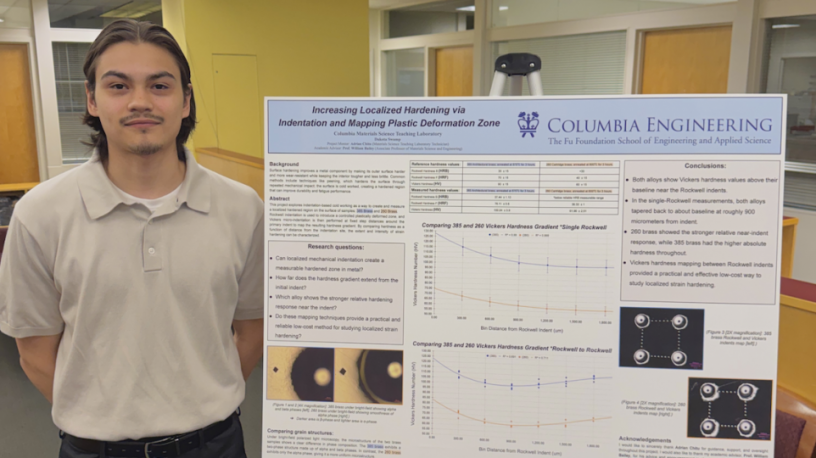
Dakota Swampt investigated localized surface hardening techniques in metallic materials, using Rockwell and Vickers micro-indentation to map hardness gradients produced through controlled cold working, with direct implications for improving wear resistance in engineering components.
Israa Draz took on the economics of climate technology, presenting a comprehensive techno-economic analysis of three solid sorbent materials for direct air carbon capture. Her findings identified Zeolite 13X as the standout candidate, achieving a levelized cost of $47.53 per ton of CO₂ — well below the DOE's 2030 target of $100 per ton — and outlined a roadmap for scaling the technology toward gigaton-level carbon removal by mid-century.
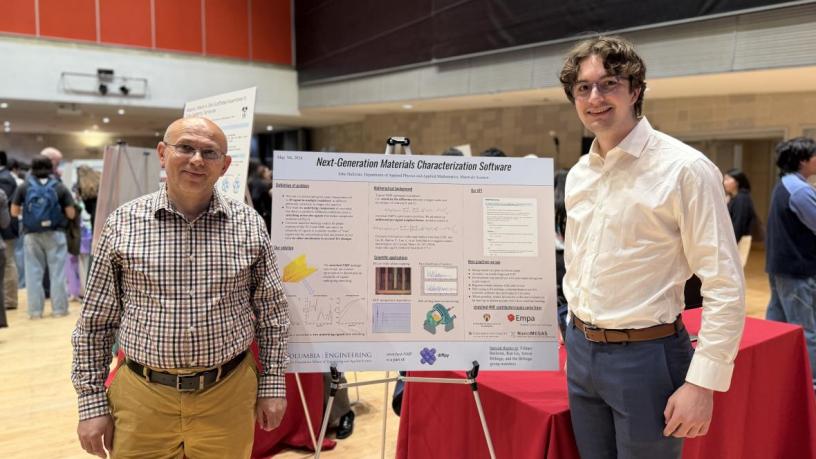
John Halloran developed diffpy.stretched-nmf, an open-source Python package that extends non-negative matrix factorization to account for thermal expansion in materials characterization data. The tool outperforms standard NMF on real experimental datasets and was built following best practices for collaborative scientific computing.
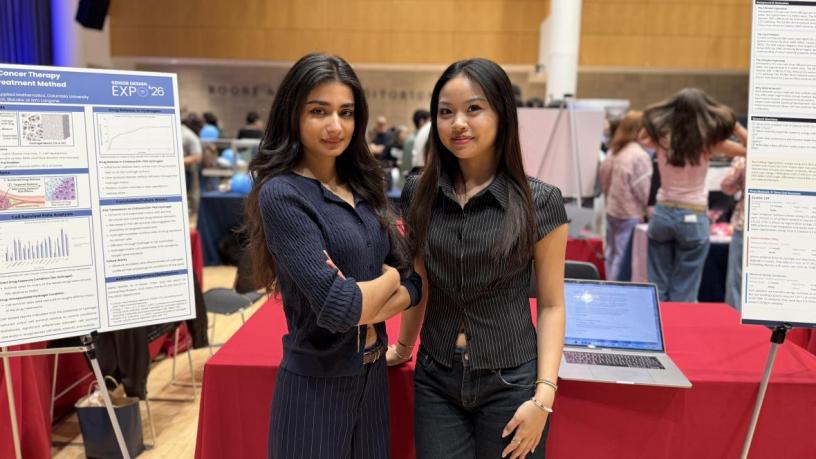
Emily Lu explored the use of chitosan-based hydrogels as a platform for localized cancer drug delivery. Her study demonstrated that a Chitosan/DF-PEG hydrogel could enable the gradual, sustained release of the anticancer drug 5-fluorouracil in T-cell leukemia cell cultures — offering a promising alternative to conventional therapies that often suffer from systemic toxicity and poor localization.
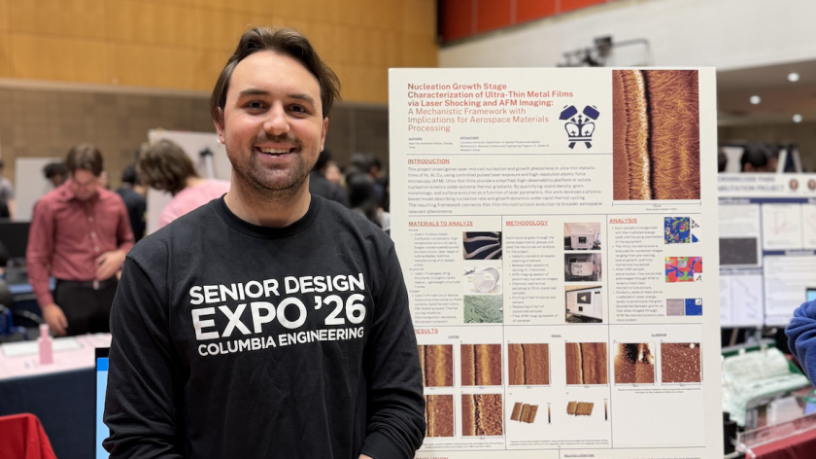
Jose Osa developed a physics-based framework for understanding laser-induced nucleation and microstructural evolution in ultra-thin films of nickel, aluminum, and copper. By connecting thin-film behavior under rapid thermal cycling to broader aerospace manufacturing phenomena — including additive manufacturing and laser shock peening — his work bridges materials science fundamentals with real-world aerospace engineering applications.
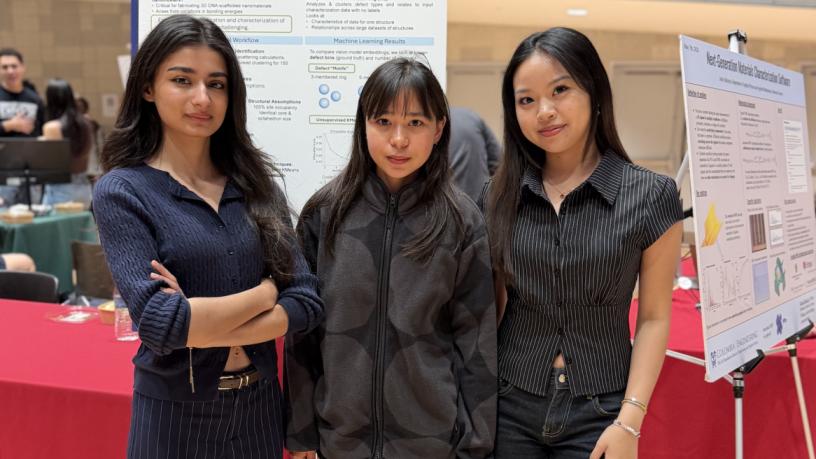
Zoe Zachko used interpretable machine learning to map structural defects in DNA-scaffolded gold nanoparticle nanoclusters to their X-ray scattering signatures. By applying KMeans clustering to scattering intensities and pair-distribution functions, she developed an analysis pipeline that can help researchers identify defect types in experimental samples where manual extraction from scattering data is impractical.
Together, these projects reflect the breadth of APAM's Materials Science and Engineering program and the ability of its students to connect rigorous scientific thinking to meaningful, real-world impact. Congratulations to the Class of 2026 — and to the faculty mentors whose guidance made this work possible.