
2025 Senior Design Projects
Two Materials Science undergrads, Sarah Asher and Jalaj Mehta, presented research at the annual Columbia Engineering Senior Design Expo on May 8th, 2025 in Lerner's Roone Arledge Auditorium. The annual event offers students the chance to demonstrate their knowledge from foundational math and science courses alongside their engineering studies through innovative, creative, and meaningful designs and prototypes.
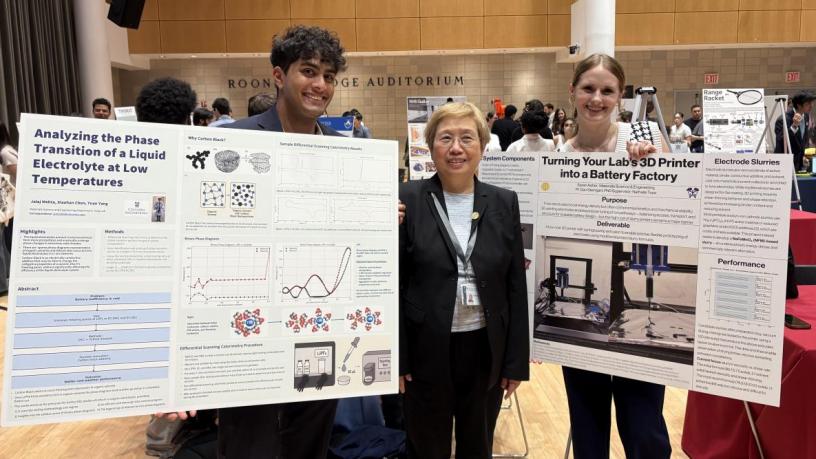
(left-right) Jalaj Mehta, Prof. Siu-Wai Chan, and Sarah Asher
Sarah Asher, BS '25, Materials Science
Project: "Turning Your Lab’s 3D Printer into a Battery Factory"
Advisor: Dan Steingart
3D printing offers a promising method for fabricating thick battery electrodes by enabling fine control over ion transport pathways. This control can enhance energy density without significantly compromising transport properties. However, direct ink writing (DIW) systems are often prohibitively expensive and inaccessible to many research laboratories. This work addresses that limitation by modifying a popular and affordable Creality Ender 3 printer with a custom 3D-printed syringe pump. This system enables precise slurry extrusion and drying. The setup was evaluated using sodium-ion cathode slurries, an underexplored printing chemistry that stands to benefit from improved electrode design due to intrinsic limitations in energy density. Slurry extrusion experiments demonstrate consistent printing performance. Future work will employ this platform to optimize slurry rheology, quantify tortuosity as a function of print geometry, and compare electrochemical performance against conventionally manufactured electrodes.
Jalaj Mehta BS '25, Materials Science
Project: "Development of Phase Diagrams for Liquid Electrolyte Solutions"
Advisor: Yuan Yang
Electric-powered devices—from small-scale lawn mowers to heavy-duty industrial trucks—represent a transformative shift away from gas-powered technology, offering cleaner, quieter, and potentially more efficient alternatives. Despite growing global interest in electrification, there remain substantial barriers to widespread adoption, particularly in regions that experience extreme cold. While lithium-ion batteries have undergone decades of development and are now the dominant energy storage solution for electric devices, their performance plateaus and temperature sensitivity have become increasingly prominent limitations. One of the most critical challenges lies in their diminished efficiency at low temperatures. In such environments, the electrolyte components within these batteries can begin to freeze, significantly hampering charge acceptance and overall performance.
Surprisingly, despite the technological maturity of lithium-ion systems, there exists a limited understanding of the phase behavior of common electrolyte mixtures under sub-zero conditions. In particular, phase transition data for LiPF₆ in ethylene carbonate (EC) and dimethyl carbonate (DMC) remains scarce, making it difficult to predict and mitigate freezing behavior in cold climates.
This work addresses two key research gaps: (1) the construction of detailed phase diagrams for the LiPF₆:EC:DMC system to characterize and predict freezing points under varying concentrations, and (2) the investigation of carbon black as an additive capable of lowering the electrolyte's freezing point without compromising conductivity or battery efficiency. By employing differential scanning calorimetry (DSC) and custom Python-based analysis tools, we have successfully mapped critical phase transition thresholds and demonstrated the potential of carbon black to enhance cold-weather performance. The findings contribute both fundamental insights into electrolyte thermodynamics and a practical strategy for improving lithium-ion battery reliability in cold environments.