
2025 Senior Award Winners
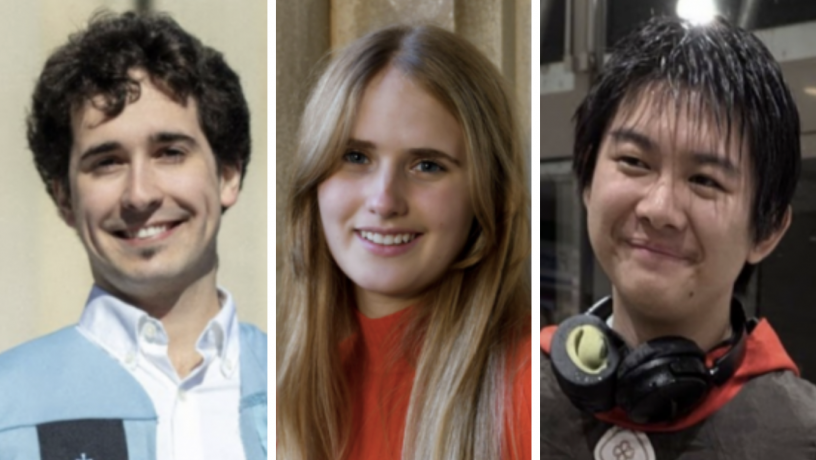
APAM Department Senior Award Winners
(left to right) Mihnea Leonte, Sarah Asher, and Andrew Yang
Professor Marc Spiegelman, Chair of the APAM Department, presented awards to three outstanding seniors at the 2025 APAM Senior Dinner and Award Ceremony. Each winner was selected by the APAM faculty in recognition of their outstanding academic achievements. (left-right, Mihnea Leonte, Andrew Yang, and Sarah Asher)
Applied Mathematics Faculty Award Winner: Mihnea Leonte
Mihnea Leonte (B.S. ’25, Applied Mathematics) is the winner of the 2025 Applied Mathematics Faculty Award. Mihnea is passionate about applying mathematics to real-world problems to create tangible impact – whether in robotics, machine learning or in finance. This motivation has shaped his academic path at Columbia, where, alongside his Applied Mathematics coursework, he pursued advanced courses in Computer Science, Economics, and Industrial Engineering. He explored topics such as Machine Learning and Unsupervised Learning, Game Theory, and Algorithmic Trading, building a strong interdisciplinary foundation. In his junior summer, he conducted research in the Applied Mathematics Department under the supervision of Prof. Xuenan Li on the design of singular and flexible bar frameworks with applications to robotics. The project brought together constrained optimization, rigidity theory, and numerical methods to study the geometry of mechanical systems. By implementing a constrained saddle search algorithm, he discovered multiple families of bar frameworks that satisfied both singularity and flexibility, achieving the project’s core objective. Together with Prof. Li, he co-authored a paper based on these results, which they submitted to a conference for review. In the Fall semester, he presented these results as part of the senior seminar. Outside of research, he regularly attended talks hosted by the Undergraduate Math Society where he enjoyed diving into more abstract and theoretical mathematical topics. After graduation, he will continue at Columbia as a Master’s student in Financial Engineering, aiming to build on his interdisciplinary foundation and apply mathematical models to complex problems in quantitative finance.
Applied Physics Faculty Award Winner: Andrew Yang
Andrew Yang (B.S. ’25, Applied Physics) is this year’s Applied Physics Faculty Award Winner. His interest lies in the intersection between physics, mathematics, and computation. His research direction has swung wildly from designing LSTMs with Prof. Zhang Rui (at the University of Minnesota) to searching for periodic singular structures with Prof. Xuenan Li. The majority of his work has been with Prof. Simon Billinge on designing fast techniques and programs to probe changes in material structure from high-throughput diffraction data. These techniques have been applied around the world including an XFEL experiment at SPring-8 in Japan. Andrew loves yapping (usually about his work) and was the first undergraduate to speak at a Bruker-AXS / MIT Symposium. He also loves outreach and teaching, though his students may question his ability on the latter. Throughout college, he has taught computer aided design to local high-schoolers through the SHAPE program as well as dynamical systems and machine learning to local Columbia students through being a TA. Andrew will continue his exploration of material structures and behaviors through (neutron) diffraction and machine learning (of interatomic potentials) at Caltech.
2025 Materials Science and Engineering Rhodes Prize: Sarah Asher
Sarah Asher (B.S. ’25, Materials Science) is this year’s winner of the Frances B.F. Rhodes Prize. She began her research at Columbia in Professor Katayun Barmak’s lab, where she developed Python code for a UNet-based grain boundary segmentation project and co-authored a related publication. She later joined the Steingart Group in Earth and Environmental Engineering, where she used signal processing to analyze acoustic data from lithium metal batteries for health diagnostics. For her Senior Design Project, advised by Professor Dan Steingart, she built a low-cost 3D printing system for electrode slurry deposition. She also served as the SEAS student government sustainability representative in her junior year. After a gap year, Sarah plans to pursue graduate research in electrochemical energy storage.