Image
Applied Physics Research
Applied Physics research focuses on plasma physics and controlled fusion; solid-state physics; and optical and laser physics.
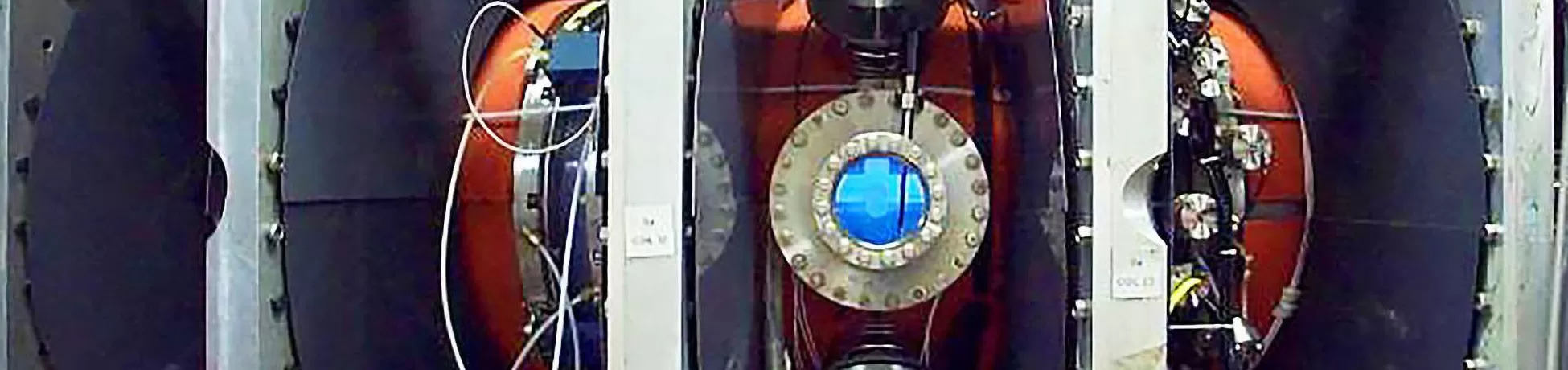
Plasma Physics and Fusion Energy
In experimental plasma physics, research is being conducted on:
- Equilibrium, stability, and transport in fusion plasmas: high-beta tokamaks, spherical tokamaks, and levitated dipoles
- Magnetospheric physics: trapped particle instabilities and stochastic particle motion
- Confinement of toroidal nonneutral plasmas
- Plasma source operation and heating techniques
- Development of new plasma measurement techniques
The results from our fusion science experiments are used as a basis for collaboration with large national and international experiments. For example, active feedback control of plasma instability developed at Columbia University are guiding research on NSTX at the Princeton Plasma Physics Laboratory, on the DIII-D tokamak at General Atomics, and for the design of the next generation burning plasma experiment, ITER. In theoretical plasma physics, research is conducted in the theory of plasma equilibrium and stability, active control of MHD instabilities, the kinetic theory of turbulence and transport, and the development of techniques based on the theory of general coordinates and dynamical systems. The work is applied to magnetic fusion, non-neutral and space plasmas.
Optical and Laser Physics
Active areas of research include:
- inelastic light scattering in nanomaterials
- optical diagnostics of film processing
- flat optics
- metasurfaces
- nonlinear optics
- ultrafast optoelectronics
- photonic switching
- optical physics of surfaces
- laser-induced crystallization
- photon integrated circuits
Solid-State Physics
Research in solid-state physics covers:
- nanoscience and nanoparticles
- electronic transport and inelastic light scattering in low-dimensional correlated electron systems
- heterostructure physics and applications
- molecular beam epitaxy
- grain boundaries and interfaces
- nucleation in thin films
- molecular electronics
- nanostructure analysis and electronic structure calculations
Applied Physics Research Groups
- Columbia Fusion Research Center
- Levitated Dipole Experiment (LDX)
- Laser Diagnostics and Solid State Physics Laboratory
- CNI: Columbia Nano Initiative
- PRO-QM: Energy Frontier Research Center
- NASA Goddard Institute for Space Studies
Applied physics is part of the Columbia Quantum Initiative. Research opportunities also exist within the Columbia Nano Initiative (CNI), including the NSF Materials Research Science and Engineering Center, which focuses on low dimensional materials.

Ever wonder how lightsabers work? Watch how plasma physics make these signature Star Wars weapons possible -- in every color of the rainbow. (5:56)