Image

Applied Mathematics Research
The core group of faculty members of the Program in Applied Mathematics have research expertise covering mathematical analysis, partial differential equations, numerical analysis, applied probability, dynamical systems, multiscale modeling, high performance scientific computation, and numerical optimization with applications in optics and photonics, material science, machine learning, data science, imaging science, biology, and climate modeling, to name a few.
In Brief: Professors Chris Wiggins and Matthew Jones on "How Data Happened'
Watch more Engineering videos
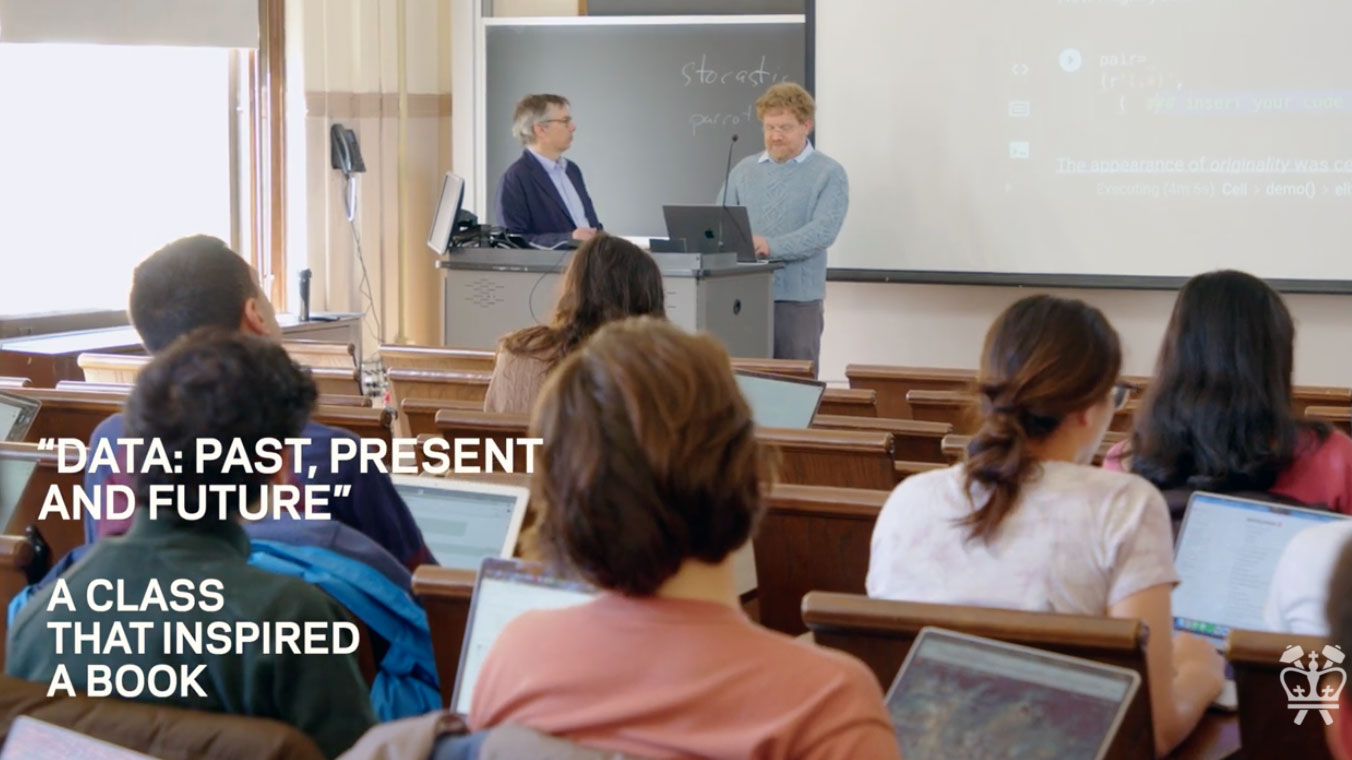
Two professors, two fields, two schools. A data scientist and applied mathematician teaching with an expert on the history of science and technology. One class, one book, one vision. We went behind the scenes with Columbia's two professors for a brief exchange on their book "How Data Happened" which emerged from their class "Data: Past, Present, and Future."
Areas of Research
-
Applied Analysis and Partial Differential Equations
This area of research focus on rigorously analyzing, mathematically and numerically, deterministic and stochastic partial differential equations in physics and engineering. Current research in this area include, but are not limited to:
- Analysis of wave propagation in novel material structures, study emergence of topologically protected states in novel material structures (such as metallic lattices and honeycomb structures) and the relations among continuum and discrete and other effective models
- Developing mathematical understanding of defect modes for dislocated periodic media and randomly perturbed media
- Designing efficient computational algorithms for simulation of edge states in different physical settings, e.g. electronic physics, optics and photonics
- Analyzing partial differential equations models for wave propagation in nonlinear media
- Analysis of nonlocal models
- Mathematical analysis of inverse problems to PDEs
We collaborate extensively with leading scientists at Columbia, especially the groups of Professor Alexander Gaeta and Professor Nanfang Yu of optics and photonics on experimental realizations of some of the theoretical and computational discoveries on wave propagation in complex structures.
-
Learning the Earth with Artificial Intelligence and Physics
The APAM Department is coordinating with LEAP — the Learning the Earth with Artificial Intelligence and Physics — an National Science Foundation Science and Technology Center that launched in 2021 to explore the intersection of Applied Mathematics, Machine Learning, Artificial Intelligence and Climate physics, all core research areas in APAM. Multiple APAM affiliates are involved in LEAP which also provides potential research opportunities for current and future students. For more information on LEAP activities and potential research opportunities, please check out the LEAP website.
-
Mathematics and Algorithms for Learning and Data Science
This area of research aims at developing mathematical understandings, as well as efficient computational algorithms, for analysis of and learning from high-dimensional data sets. The current research topics in this area include, for instance:
- Analyzing approximation abilities of deep ReLU networks, especially their ability in lessening the curse of dimensionality, and the training behavior of such networks
- Studying mathematical properties of nonlocal deep neural networks and their connections with existing nonlocal models for machine learning
- Developing data-driven compressive sensing methods for sparse representation of solutions to systems of stochastic differential equations
- Analyzing impacts of different loss functions (for instance those based on the Wasserstein metrics) on training results of deep neural networks
- Developing and implementing novel optimization algorithms, such as variants of stochastic gradient descent methods and subsampled Gauss-Newton methods, for training of deep neural networks.
There are extensive collaborations with researchers at the Data Science Institute (DSI) on applications of learning and data techniques in genome sequencing and genetics, cancer dynamics modeling, as well as magnetic resonance imaging and scanning tunneling microscope.
-
Mathematics of Inverse Problems and Imaging
This area of research focuses on theoretical and computational issues in inverse problems for partial differential equations emerged in novel imaging modalities. The current research topics in this direction include:
- Developing uniqueness and stability theory for inverse coefficient problems for system of elliptic partial differential equations with internal data
- Analyzing mathematically inverse problems for kinetic transport equations in photoacoustic molecular imaging
- Developing partial differential equations models for quantitative photoacoustic imaging of complex media with nonlinear physics such as multi-photon absorption and second harmonic generation
- Developing uniqueness and stability theory for multi-physics inverse problems that couples hyperbolic and elliptic PDEs
- Studying uncertainty quantification issues in inverse problems and imaging where different types of imperfect information could have significant impacts on the reconstructed quantities
This area of research is closely connected to biomedical imaging research on Columbia’s campus, including, for instance, Professor Andreas Hielscher's group in optical imaging and Professor Thomas Vaughan's center for high-field magnetic resonance imaging (MRI).
-
Mathematics for Physics- and Data-enabled Material Discovery
This research area involves strong collaborations with the Material Science Program at Columbia to pursue mathematical understanding on some key issues in material science. Recent directions of research in this area include:
- Developing efficient computational algorithms, for instance, asymptotically compatible discretization schemes, for nonlocal models in material modeling
- Understanding of the nonlocal equations involved in Smoothed Particle Hydrodynamics (SPH) for complex fluid flow simulation
- Developing and verifying peridynamic models for simulating brittle fracture, developing corresponding computational methods for the models, analyzing well-posedness of the models
- Developing fast and accurate algorithms for simulating coarsening dynamics of local and nonlocal Cahn-Hilliard equations
- Developing mathematical understanding and computational simulation tools, such as those based on phase field models, for grain boundaries
- Constructing efficient and robust deep convolutional neural network models (CNN) for material micro-structure prediction from measured X-ray atomic pair distribution functions
- Incorporating physics-based models, such as the Debye scattering equation, into data-driven models for structure interpretation from PDF data
- Developing mathematical theory and computational algorithms for stochastic homogenization problems in material modeling.
This research area is in close collaboration with Columbia experimentalists, especially the groups of Professor Simon Billinge and Professor Katayun Barmak, on both the validation of the models and algorithms developed with experimental data, and the usage of these mathematical and computational tools for material discovery. e. Physics- and Data-based Earth Science Research.
-
Physics- and Data-based Earth Science Research
Columbia’s Applied Mathematics Program has a successful tradition in mathematics of earth sciences, especially atmospheric science, climate modeling and dynamics of geophysical fluid-solid coupling. Currently, research activities in this area focus mainly on:
- Analyzing and modeling multi-physics phenomenon inside the earth, including (a) developing mathematical understanding on coupled fluid-solid mechanics, for instance magma dynamics and carbon sequestration process, and developing high-performance computational methods for simulating such systems; (b) developing mathematical and physical models for reactive flows in brittle media inside the earth.
- Physics- and data-driven uncertainty quantification, including (a) developing generic data-driven reduced order modeling methods, based on sparse representation and deep neural networks, for general uncertainty quantification applications; (b) developing data-driven surrogating models for PDE based computational inference, model calibrating, optimization and inversion in geophysical flow simulation with model uncertainties.
- Climate modeling, including (a) developing simplified mathematical models for the understanding of climate dynamics; (b) develop statistical and computational models to study climate and weather predictability.
Many members of the mathematical earth science group, such as Professor Lorenzo Polvani, Professor Adam Sobel, and Professor Marc Spiegelman, have joint appointments at the Department of Earth and Environmental Sciences. The group also engages in ongoing research and instruction with the Lamont-Doherty Earth Observatory and the NASA Goddard Institute for Space Studies where world class research in earth sciences are conducted.