Faculty & Staff
Steven Sabbagh Honored with Korea Fusion Energy Development Award
Columbia APAM researcher recognized as sole U.S. scientist among Korean honorees at the Korea Fusion Energy Development Forum in Daejeon to commemorate the launch of the KSTAR project.
November 16, 2026
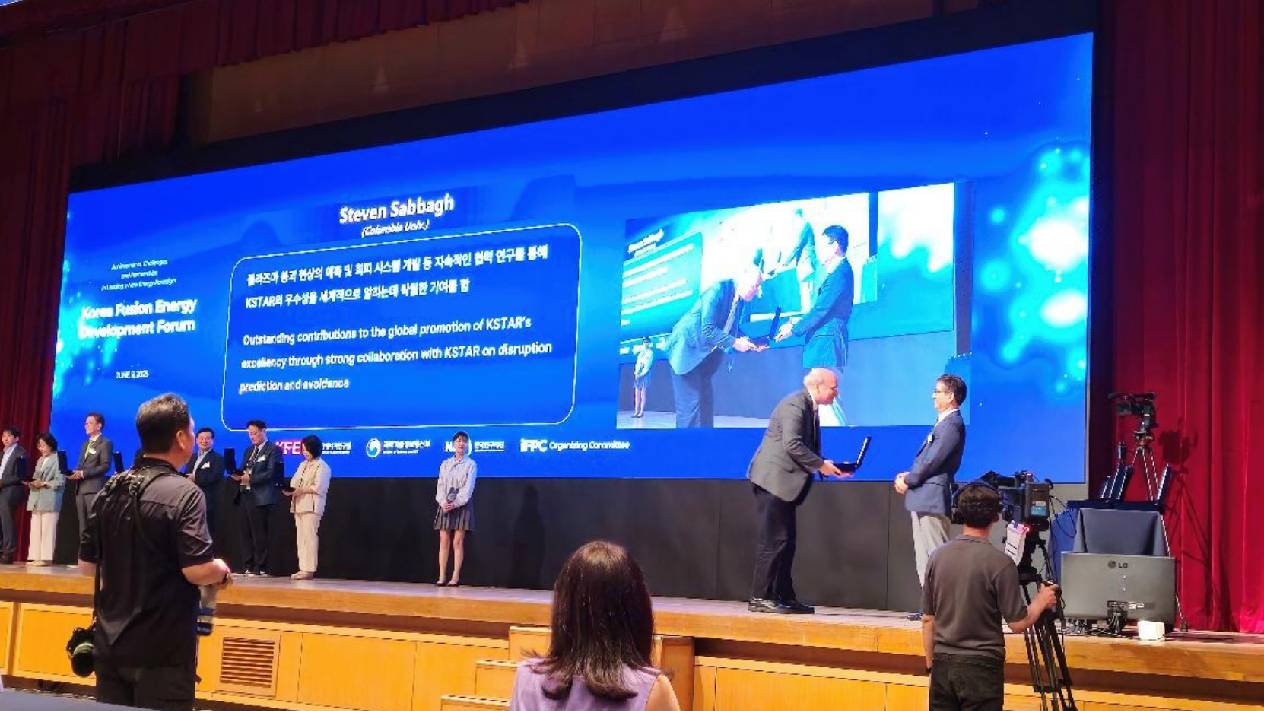
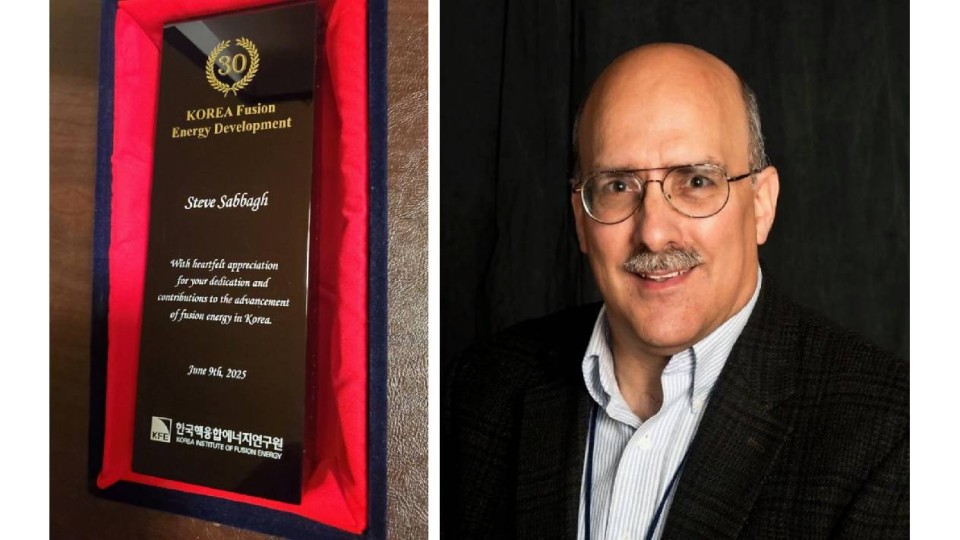
Dr. Steven A. Sabbagh, Adjunct Professor of Applied Physics, Senior Research Scientist in the Department of Applied Physics and Applied Mathematics (APAM), and APAM alumnus (Ph.D. ’90), was honored with a Korea Fusion Energy Development Award. The award was presented on June 9, 2025 by Korea Institute of Fusion Energy (KFE) President Dr. Yeongkook Oh at the Korea Fusion Energy Development Forum, held at the Daejeon Convention Center in Daejeon, South Korea, in conjunction with the 4th International Fusion and Plasma Conference (iFPC 2025). Hosted by KFE, the forum commemorated the 30th anniversary of the launch of the Korea Superconducting Tokamak Advanced Research (KSTAR) project. Typically given only to Korean physicists and institutional leaders to honor major, multi-year contributions to South Korea’s fusion program, the recognition named Sabbagh as the lone U.S. honoree among Korean honorees —reflecting a multi-decade, hands-on scientific partnership that helped shape KSTAR’s core operational capabilities.
On long-term assignment at the Princeton Plasma Physics Laboratory (PPPL), Sabbagh and his Columbia research group have been deeply embedded in KSTAR’s physics operations since the superconducting tokamak’s earliest campaigns following first plasma in 2008 and its first high-confinement (H-mode) discharge in 2010. Working side-by-side with KFE scientists, his team co-authored foundational studies defining KSTAR’s equilibrium operating space, high-normalized-beta limits, and magnetohydrodynamic (MHD) stability boundaries, helping establish equilibrium reconstruction and stability codes as everyday operational tools in Daejeon.
Because KSTAR employs superconducting magnets capable of long-pulse operation—routinely sustaining plasmas for tens to over a hundred seconds—suppressing slow-growing instabilities is essential to maintaining plasma performance and protecting machine components. Sabbagh assisted in the physics design and experimental implementation of the KSTAR active 3D magnetic coil control system and neoclassical toroidal viscosity (NTV) plasma rotation control on KSTAR. These advances also enabled the installation of active resistive wall mode (RWM) control on the device.
Since 2016, Sabbagh has also served as lead Principal Investigator for a flagship multi-institutional U.S. Department of Energy collaboration—spanning Columbia, PPPL, and MIT—dedicated to real-time disruption prediction and avoidance on KSTAR. Through this partnership, his group designed, constructed, and implemented the Disruption Event Characterization and Forecasting (DECAF) framework directly into KSTAR’s real-time plasma control system. At iFPC 2025, Sabbagh delivered an invited talk highlighting milestone demonstrations of the first real-time disruption forecasting and avoidance using DECAF in long-pulse superconducting plasmas on KSTAR achieved through this effort (https://www.apam.columbia.edu/about/news/first-demonstration-tokamak-disruption-avoidance-disruption-event-characterization-and-forecasting). The result was highlighted by KFE President Oh during the initial plenary presentation of the meeting, as well as being simultaneously shown by former KFE President Dr. Keeman Kim at the International Atomic Energy Agency Ninth DEMO and Fusion Plants Workshop meeting held in Aomori, Japan.
Beyond control algorithms and hardware, the collaboration has fostered more than 15 years of close mentorship and scientific exchange across New York, Princeton, and Daejeon, training a generation of early-career researchers working on both U.S. and Korean fusion facilities. The Korea Fusion Energy Development Award recognizes both the technical milestones of that partnership and Sabbagh’s enduring contributions to steady-state magnetic fusion energy.
Korea Fusion Energy Development Award