Research
Bridging High Energy and Fusion Physics: APAM’s Steven Sabbagh Presents at BNL FUSION-X Workshop
November 16, 2026
Steven A. Sabbagh
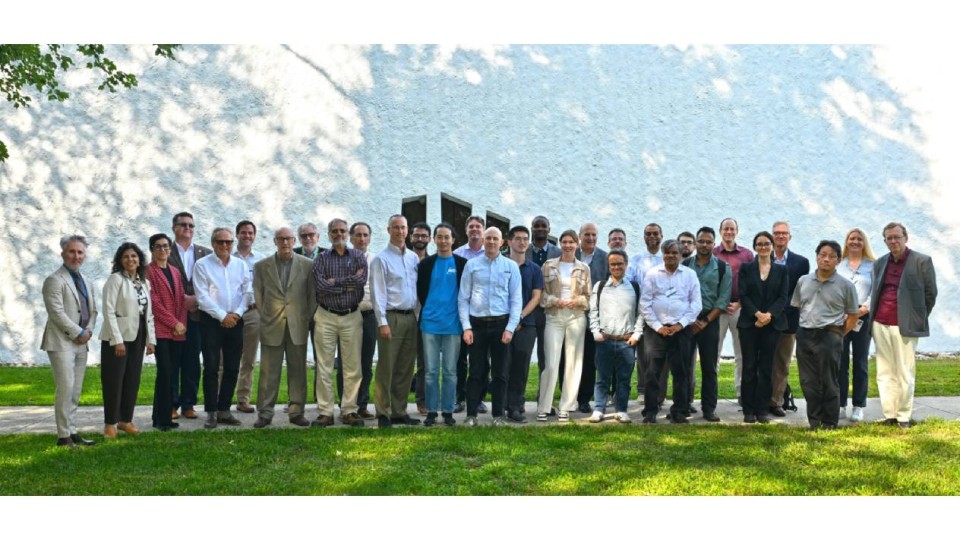
On September 17, 2026, Dr. Steven A. Sabbagh, Senior Research Scientist and Adjunct Professor in Columbia's Department of Applied Physics and Applied Mathematics (APAM), delivered an invited presentation at the FUSION-X @ BNL Workshop at Brookhaven National Laboratory (BNL). The innovative event, themed "Collaborate, Innovate, Ignite," was organized to bring together researchers from the high energy physics (HEP) and magnetic confinement fusion communities to explore cross-disciplinary synergies in extreme materials, enabling technologies, and nuclear data. APAM’s Dr. Jeff Levesque also participated in the workshop.
On long-term assignment at the Princeton Plasma Physics Laboratory (PPPL), Dr. Sabbagh presented his talk, "Tokamak Magnetic Confinement Fusion Energy Lightning Round Aimed Toward Research Collaboration," during the workshop's Enabling Technologies session. His presentation provided a rapid overview of the state of tokamak experiments—from historic breakthroughs produced in DT plasmas on TFTR and JET (Dr. Sabbagh having run high fusion power DT plasma experiments on TFTR) to modern advancements on the KSTAR tokamak, the design of SPARC, and the upcoming upgraded spherical tokamak NSTX-U — to motivate direct collaboration discussions with BNL scientists.
Sabbagh mapped out a wide spectrum of shared challenges between HEP and fusion science. He emphasized that instrumentation and diagnostics represent immediate, "low-hanging fruit" for collaboration, pointing to mutual needs in radiation-hardened electronics, neutron-resilient optics, and ultra-fast, real-time data acquisition systems.
A major focal point of his talk and the subsequent roundtable discussions was the ubiquitous role of artificial intelligence. Sabbagh highlighted his group's pioneering work on the DECAF (Disruption Event Characterization and Forecasting) framework, which utilizes multi-physics models to predict and avoid plasma disruptions in real time. During the workshop, this research intersected directly with BNL's Genesis Mission efforts to develop AI-driven, self-learning digital twins for particle accelerators.
Beyond his formal presentation, Dr. Sabbagh was an active voice in the workshop's collaborative roundtables. In the Modeling and Nuclear Data thrust, he contributed expert insights on DD neutron production capabilities in NSTX and the significantly higher outputs anticipated from the coming NSTX-U at PPPL (first plasma expected during the first half of 2027), helping to bridge the gap between fusion reactor validation needs and existing nuclear data capabilities.
By charting a clear path for shared technology development—from high-temperature superconducting magnets to AI-enabled control systems—Dr. Sabbagh’s participation at FUSION-X highlights APAM's ongoing leadership in building the interdisciplinary networks required to deliver practical fusion energy.